You know you’ve got writer’s ADHD when you’re juggling two books at once and still somehow lose three hours designing an elaborate, color-coded annual calendar of fictional festivals.
Not just any calendar—one that maps plot twists, tropes, emotional arcs, and seasonal symbolism across an entire series. Because obviously the town has moods, and those moods belong in spring.
It starts as research and quietly becomes worldbuilding obsession. Always weaving—stories, timelines, characters, the fictional town itself. Threads layered over threads until everything feels connected… or at least convincingly tangled.
A diversion, technically.
Because I should be working on Love Marks. I’m about 10,000 words into the first draft, and in the last 48 hours I’ve realized something mildly devastating: the plot needs a major overhaul.
So, yes. Sigh.
That means most of those 10,000 words are headed for the digital archive labeled “unused, but I can’t delete this yet.” A holding pen for scenes that didn’t survive contact with the story’s evolving reality.
And that’s fine. Starting over is part of the process. Not every sentence is sacred. That lesson arrives quickly when you work with editors and proofreaders who are excellent at their jobs—and even better at having opinions.
The truth is, writing improves when you stop treating every draft like a monument. It becomes more like a conversation: messy, iterative, alive. Feedback sharpens it. Resistance refines it. The work is always stronger for it.
Still, I keep the old material. There’s a folder full of abandoned scenes, half-built characters, and dialogue that almost worked. I tell myself I’ll delete it eventually.
I won’t. Not yet.
Occasionally I dig into those “dead files” and find a line, a gesture, a fragment that clicks into something new. I don’t reuse whole sections, but every so often there’s a spark worth salvaging—like mining something you didn’t know you dropped.
This week’s plot avoidance also led me down a different rabbit hole: planning a train daytrip to Chicago. There’s something perfect about living close enough to hop on a train, spend a day in world-class museums, and be back in your own bed by nightfall. A reset button disguised as travel.
Not everything is stuck, though.
Love Pop is done—first draft complete and set aside for now. It needs distance before I can see it clearly instead of through the lens of having just written it. Future-me will handle that conversation.
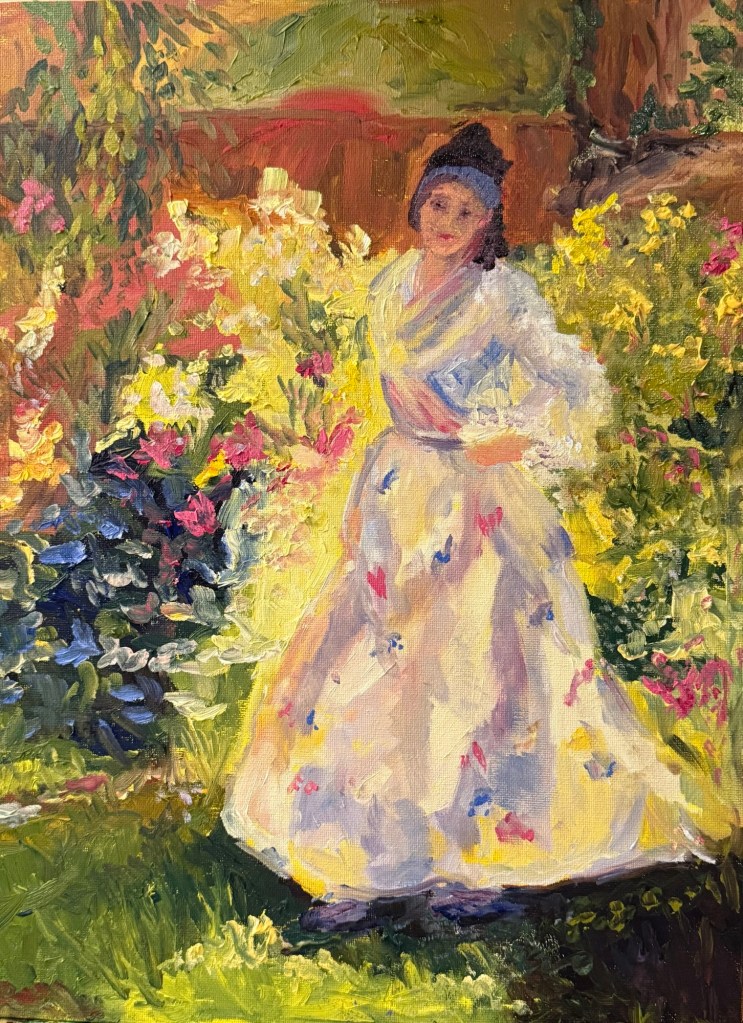
In the meantime, I’ve been taking classes at the local art center. I don’t usually paint in oils (too messy, too unpredictable, too good at ending up on my clothes), but there’s something grounding about sitting with other amateur artists, studying a classic work, and trying to recreate it stroke by stroke.
It’s quietly therapeutic. No pressure to be brilliant. Just observation, imitation, adjustment.
I’m a thirsty learner. A day that includes learning something new feels like a day that counted. The dopamine hit is real, and I’m not pretending otherwise.
Visual art helps in another way too—it teaches me how to play without overthinking it. To quiet the inner critic long enough to experiment. Not everything has to be precious. Some things are just practice.
I’ve made enough questionable pottery to prove that point. Some pieces lasted briefly on a shelf. Some were smashed and thrown out. Letting go of the bad work is its own skill. Making room is part of the process.
The next page is always better for what the last one taught you.
And now it’s almost May.
We’ve visited the local greenhouse, filled the planters around the condo, and I’ve pulled the deck cushions out of their winter hiding place in the crawl space. Birds are returning in waves—migratory visitors turning ordinary mornings into small surprises.
Baltimore orioles, scarlet tanagers, indigo buntings—colors so vivid they feel improbable, like something generated rather than grown.
But no. That’s just spring doing what it does.
Even the wood ducks, in all their ridiculous brilliance, insist on being real.
Maybe that’s the pattern underneath all of it—not the perfect plot, not the finished draft, but the constant return to making things.
Starting, stopping, revising. Keeping what almost worked. Letting go of what didn’t. Getting distracted and somehow circling back anyway.
If you’re doing anything creative—writing, painting, building, learning—you probably recognize this rhythm. Progress rarely moves in a straight line. It moves like weather across a map you’re still drawing.
Some days you’re building the story. Some days you’re rebuilding yourself around it.
And most days, you’re just trying to stay curious enough to keep going.
So if your own version of Love Marks is sitting unfinished, or your calendar of imaginary festivals has taken over an afternoon, or you’ve started over more times than you can count—you’re in good company.
We’re all just weaving something.


Leave a Reply